
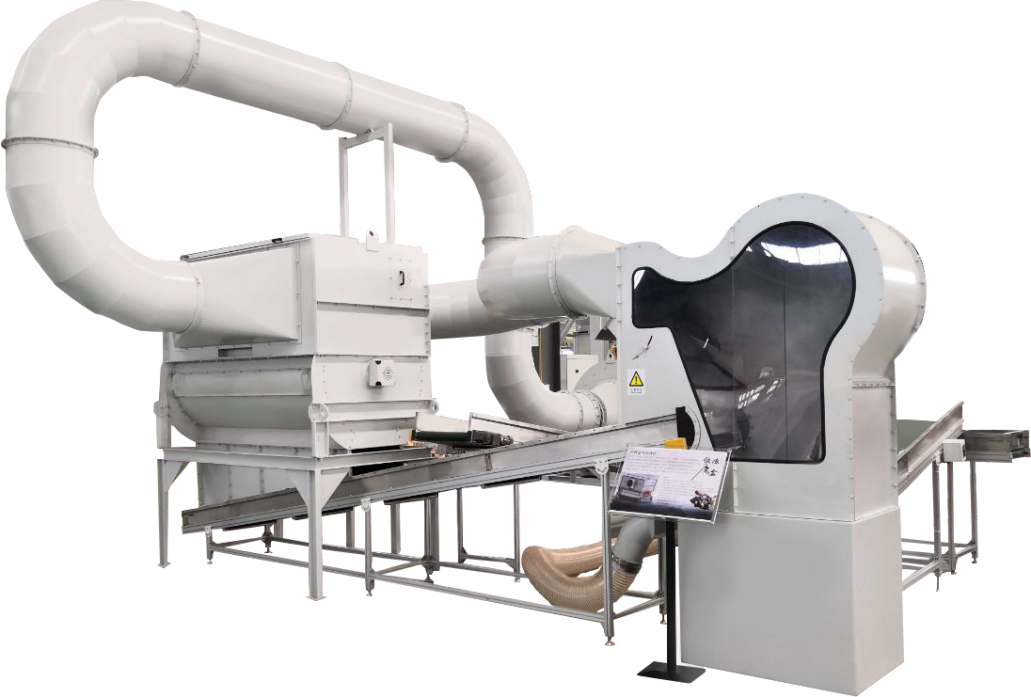
Product Overview
The negative-pressure air separator is a closed-loop airflow sorting system purpose-built for separating light and heavy materials in mixed plastic solid waste. It excels at efficiently separating shredded plastic bottles from lightweight contaminants such as film and paper fluff, handling materials up to 30-300 mm. Widely deployed in PET bottle recycling, plastics reprocessing, and municipal solid waste recovery, it is the core equipment for precision sorting of plastic solid waste.
The equipment employs a negative-pressure closed-loop air circuit design. After material enters the sorting chamber through the feed end, plastic bottles fall and discharge by gravity and inertia, while lightweight materials such as plastic film and paper scraps are drawn upward by negative-pressure airflow generated by the overhead hood and conveyed through ducting to the downstream rotary air separator. Inside the rotary air separator, the film material separates from the airflow and drops naturally for collection, while clean air recirculates back to the fan through the ductwork, forming a closed-loop air system with zero dust emission. Airflow is infinitely adjustable via a variable-frequency fan, combined with an adjustable hood structure to precisely control airflow intensity, achieving stable separation of light and heavy materials and resolving common pain points of conventional open-type air separators such as dust pollution, low sorting accuracy, and incomplete light-impurity removal.
The equipment features a fully modular, sealed structure operating under negative pressure throughout the entire process, effectively preventing dust leakage and ensuring a clean working environment. Equipped with an electrical overload protection system and wear-resistant consumable parts, it delivers stable operation with a low failure rate. Easy disassembly and maintenance make it suitable for long-term continuous industrial operation, combining high efficiency, environmental compliance, and versatility — the ideal solution for achieving high-efficiency sorting in the plastics recycling industry.
Key Advantages
The equipment adopts a full-process negative-pressure sealed structure. All joints between air ducting, the sorting chamber, and the rotary air separator are sealed with sealant, and critical flange connections are fitted with gaskets to effectively eliminate air leakage and dust emission, ensuring stable sealing performance throughout the machine. The closed-loop airflow circulation design returns clean air to the fan after separation in the rotary air separator, with no external dust discharge.
The fan is equipped with a variable-frequency motor allowing impeller speed adjustment. Speed can be flexibly adjusted in real time based on material type, moisture content, specific gravity, and throughput to precisely match optimal sorting conditions, stably control airflow intensity and sorting trajectory, effectively improve separation accuracy and purity of light and heavy materials, and meet diverse material sorting requirements for efficient, stable operation.
The equipment features an infinitely variable speed control system via the variable-frequency fan, allowing flexible adjustment of air volume and negative-pressure intensity based on material type, impurity content, and sorting requirements to precisely match optimal sorting performance across different working conditions with strong adaptability. Key sections use flexible connections and gasket structures to effectively compensate for assembly tolerances, providing ample installation redundancy to prevent air leakage or assembly difficulties caused by manufacturing or installation deviations, while reducing equipment maintenance and adjustment costs. The air outlet is equipped with a peak-regulating damper plate to adjust outlet air velocity for different materials.
A professional electrical overload protection system is provided. Should conditions such as overload operation or abnormal current arise, the system automatically alarms and shuts down to prevent damage from overload. The main structure uses galvanized sheet steel with a modular design, and the fan and motor are connected via V-belts for enhanced rotational stability, suitable for high-dust, high-impact operating conditions. The fully sealed structure reduces dust erosion, while flexible sealing components and a vibration damping system minimize operating wear, delivering strong overall durability and a long service life.
-
Excellent overall airtightness with matching dust collection equipment
-
Adjustable fan impeller speed for precise sorting matching
-
Adjustable air duct parameters with low operating costs
-
Intelligent protection for extended equipment service life
Technical Specifications
| Item | Model / Value | Remarks |
|---|---|---|
| Model | FHZ1200 | - |
| Dimensions (L x W x H) m | 10 x 4 x 10 | Varies with specific equipment layout |
| Weight (t) | 3 | Varies with specific equipment layout |
| Processing Capacity (t/h) | 2-3 | Fluctuates based on material properties and screening standards |
| Sorting Efficiency | >= 95% | - |
| Feed Width (mm) | 1200 | - |
| Discharge Valve Motor Power (kW) | 4 | IP55 protection rating |
| Fan Power (kW) | 37 | IP55 protection rating |
Application Scenarios
Recycling Industry: used for density-based sorting of materials such as waste plastics, PET bottles, and mixed recycled materials, efficiently removing lightweight contaminants such as film, paper fluff, and fibers, precisely concentrating heavy materials to meet the production demands of refined plastic recycling and high-efficiency recovery.
Case Study
Recycling Recovery Project: deployed in waste plastics, PET bottle recycling, and mixed recycled material sorting lines to achieve efficient separation of plastic bottles from lightweight contaminants such as film, paper fluff, and fibers, precisely removing light impurities and concentrating high-purity bottle material. The equipment adapts to complex conditions with high impurity content and heavy dust, delivering stable, controllable sorting accuracy that significantly improves recovered material purity and processing efficiency, maximizing the resource utilization value of recycled plastics.