
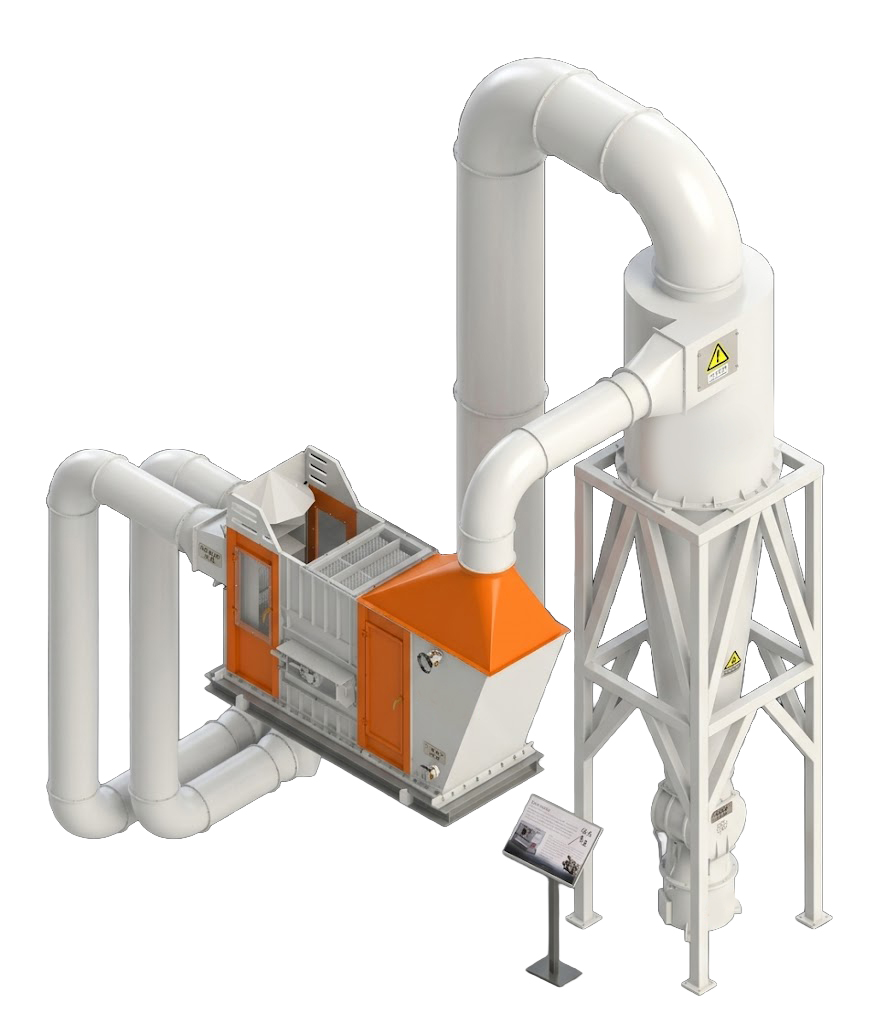
Product Overview
The light material separator is a high-efficiency airflow sorting system purpose-built for separating light and heavy materials in mixed solid waste. It leverages density differences for precise material sorting across a wide range of scenarios including municipal solid waste, construction and renovation waste, aged waste, industrial slag, and recycled aggregates. It is the core sorting equipment for solid waste recovery, waste classification, and recycled building materials processing.
The equipment features an enclosed settling chamber supported by a variable-frequency fan system that generates stable, controllable airflow. Separation of light and heavy fractions is achieved based on the force exerted by high-velocity airflow on materials and their density differences. After material enters the sorting chamber and spreads evenly, lightweight materials such as plastics, film, paper scraps, and textiles are drawn by airflow into the settling and collection unit, while heavy materials such as brick, concrete, metal, and glass fall and discharge along a gravity trajectory. During operation, airflow remains consistently stable with a clear trajectory, enabling contact-free, high-efficiency separation. The fan system is infinitely adjustable to accommodate different materials and purity requirements. Light materials are centrally collected after separating from the airflow in the settling chamber, while heavy materials are smoothly conveyed to the discharge outlet, completely resolving industry pain points such as screen clogging, sticky-material adhesion, incomplete light-impurity removal, and severe wear common to conventional screening equipment.
The overall structure is designed with ergonomics in mind, with the main body using modular assembly for convenient maintenance. It is equipped with negative-pressure dust collection, sealed dust suppression, variable-frequency speed control, and electrical overload protection systems, balancing sorting efficiency, operational stability, and workplace safety. The equipment also features low noise, a low failure rate, and simple disassembly and maintenance, significantly reducing operating costs and manual labor intensity. It supports long-term continuous industrial operation with exceptional versatility and practicality.
Key Advantages
The equipment adopts a sealed structural design. All joints between settling chamber modules are sealed with dedicated sealant, and duct connection points are fitted with high-density gaskets to effectively eliminate air leakage and dust emission, ensuring overall sealing performance. A cyclone dust collector is standard equipment, efficiently capturing process dust, purifying the working environment, reducing dust pollution, and fully meeting environmental and safety requirements.
The fan is equipped with a variable-frequency motor allowing impeller speed adjustment. Speed can be flexibly adjusted in real time based on material type, moisture content, specific gravity, and throughput to precisely match optimal sorting conditions, stably control airflow intensity and sorting trajectory, effectively improve separation accuracy and purity of light and heavy materials, and meet diverse material sorting requirements for efficient, stable operation.
The drum is mounted on slider bearings, allowing the distance between the drum and feed inlet to be adjusted based on material conditions. Adjustable-angle guide vanes inside the air outlet enable airflow velocity at the outlet to be fine-tuned within a certain range. A material-spreading boss is configured below the feed inlet to effectively thin the material curtain, creating favorable conditions for pneumatic sorting. Flexible hose connections between ducting and the main equipment body effectively compensate for assembly tolerances, providing ample installation redundancy to prevent fit-up issues caused by manufacturing or installation deviations.
A professional electrical overload protection system is provided. Should conditions such as overload operation or abnormal current arise, the system automatically alarms and shuts down to prevent damage from overload. The main structure uses galvanized sheet steel with a modular design, and the fan and motor are connected via V-belts for enhanced rotational stability, suitable for high-dust, high-impact operating conditions. The fully sealed structure reduces dust erosion, while flexible sealing components and a vibration damping system minimize operating wear, delivering strong overall durability and a long service life.
-
Excellent overall airtightness with matching cyclone dust collector
-
Adjustable fan impeller speed for precise sorting matching
-
Adjustable key components with extremely low operating costs
-
Intelligent protection for extended equipment service life
Technical Specifications
| Model | FXQ1200 | FXQ2000 | Remarks |
|---|---|---|---|
| Dimensions (L x W x H) m | 7 x 6.4 x 10 | 12 x 7 x 13 | Varies with specific equipment layout |
| Weight (t) | 8 | 12 | Varies with specific equipment layout |
| Processing Capacity (m³/h) | 25-45 | 30-50 | Fluctuates based on material properties and screening standards |
| Sorting Efficiency | >= 95% | >= 95% | - |
| Feed Particle Size (mm) | <= 100 | <= 100 | - |
| Feed Width (mm) | 1200 | 2000 | - |
| Drum Motor Power (kW) | 4 | 7.5 | - |
| Fan Power (kW) | 90 | 110 | IP55 protection rating |
Application Scenarios
-
Solid Waste Treatment: suitable for light-heavy separation of mixed materials such as municipal solid waste, aged waste, industrial waste, and construction and renovation waste, efficiently removing lightweight contaminants such as aggregate and wood chips to support waste reduction and resource recovery.
-
Infrastructure and Earthwork: enables separation of lightweight floating debris from engineering spoil, backfill earth, and crushed sand and gravel aggregates, achieving aggregate purification and spoil resource recovery to improve recycled building material quality.
-
Recycling Industry: used for density-based sorting of various recycled metals, plastics, wood, and other recovered materials, removing light impurities and concentrating heavy materials to meet the production demands of refined material sorting and high-efficiency recovery.
Case Study
-
Municipal Solid Waste Treatment Project: Multiple light material separators deployed in MSW and aged waste sorting lines perform light-heavy separation on mixed materials, efficiently removing lightweight contaminants such as plastics, film, and paper scraps. The equipment operates continuously and stably with no clogging and high sorting purity, significantly improving waste resource recovery rates and supporting harmless, volume-reduced municipal solid waste treatment.
-
Construction and Renovation Waste Project: Applied in crushing and recycled sand-and-gravel screening for construction and demolition waste, performing classification of recycled aggregates and precisely separating coarse and fine fractions. The equipment operates with low noise and stability, is easy to maintain, effectively reduces production line operating costs, and markedly improves finished aggregate quality.
-
Recycling Recovery Project: Deployed in industrial slag and scrap metal recycling lines to achieve high-efficiency light-heavy material separation, removing light impurities and concentrating heavy materials. The equipment adapts to complex operating conditions with stable sorting accuracy, significantly improving recovered material purity and processing efficiency.