
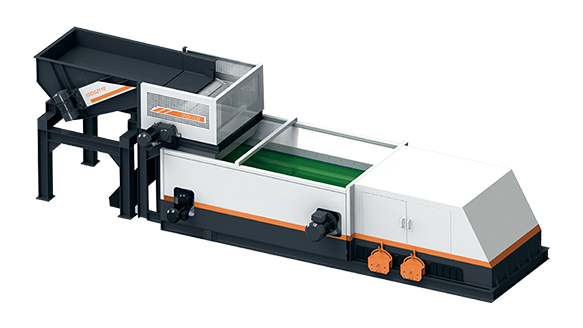
Product Introduction
The eddy current separator is a high-efficiency non-ferrous metal sorting device based on the principle of electromagnetic induction. Its core components include a high-frequency magnetic roller, sorting channel, and drive system. A rapidly rotating magnetic roller generates an alternating magnetic field. When non-ferrous metals (copper, aluminum, alloys, etc.) pass through this field with the material stream, they induce eddy currents and experience Lorentz forces, propelling them out of the material stream. Non-metallic materials continue along their original trajectory, achieving precise separation.
The equipment is suitable for multiple scenarios including construction and renovation waste, dismantled home appliances, and industrial waste residue. It features high sorting efficiency, high purity, stable operation, and easy handling, significantly increasing metal recovery value. It is a core sorting device in the resource recycling industry.
Core Advantages
The core component uses a rare-earth permanent magnet array high-frequency magnetic roller, optimally arranged to form a strong-gradient alternating magnetic field. The field strength is high and uniformly distributed, providing stable and efficient magnetic field support for sorting operations and effectively improving sorting accuracy and operational stability.
Equipped with an adjustable material guide device, the angle and position of the guide plate can be flexibly adjusted via a handwheel, precisely controlling the material drop trajectory and entry state into the magnetic field. This efficiently accommodates various types of solid waste containing non-ferrous metals of different types and particle sizes, enabling targeted and optimized sorting.
The entire machine features a modular layout, with core units (magnetic roller, drive system, sorting channel) that are compact and easy to disassemble and assemble. This reduces equipment maintenance difficulty and facilitates component inspection and replacement, ensuring long-term continuous and stable operation.
The equipment is equipped with a professional electrical overload protection system. When anomalies such as abnormal current or overload operation occur, it automatically triggers an alarm and shuts down, effectively preventing equipment damage from overloading. The core magnetic roller is treated for wear and corrosion resistance, the sorting channel uses wear-resistant materials, and key wear parts have high durability, making the unit suitable for complex working conditions with high dust and heavy impact. The entire machine adopts a modular sealed design that reduces dust ingress and minimizes component wear, resulting in strong overall equipment stability and a long service life.
-
High-efficiency strong magnetic sorting, stable and reliable accuracy
-
Adjustable guide device, strong adaptability
-
Modular structural design, convenient and efficient maintenance
-
Intelligent protection, long equipment service life
Technical Specifications
| Item | FAX0630 | FAX0830 | FAX1003 | FFX1503 | FAX2003 | Notes |
|---|---|---|---|---|---|---|
| Model | FAX0630 | FAX0830 | FAX1003 | FFX1503 | FAX2003 | - |
| Dimensions (L x W x H) m | 4 x 1.3 x 1.2 | 4 x 1.5 x 1.2 | 4 x 1.7 x 1.2 | 4 x 2.2 x 1.2 | 4 x 2.7 x 1.2 | - |
| Processing Capacity (t/h) | 5—10 | 8—12 | 10—15 | 15—25 | 20—30 | Varies depending on material properties and screening standards |
| Sorting Efficiency | >=95% | - | - | - | - | - |
| Magnetic Drum Outer Diameter (mm) | 508 | - | - | - | - | - |
| Magnetic Core Roller Speed (rpm) | 2900 | - | - | - | - | - |
| Working Width (mm) | 600 | 800 | 1000 | 1500 | 2000 | - |
| Magnetic Core Roller Power (kW) | 3.0 | 4.0 | 5.5 | 7.5 | - | - |
| Drive Roller Power (kW) | 1.5 | 2.2 | 3.0 | 4 | - | - |
Application Scenarios
-
Solid Waste Treatment: Suitable for sorting and recovering non-ferrous metals from household waste, aged waste, industrial waste, and construction and renovation waste. Efficiently separates metals such as aluminum and copper from non-metallic materials, supporting solid waste reduction and resource recovery.
-
Recycling Industry: Used for enriching and classifying non-ferrous metals in recycled materials such as scrap metal, steel mill tailings, and electronic waste. Achieves refined sorting of metal materials, meeting the high-purity production requirements of downstream recycling and processing.
-
Other Industries: Suitable for removing metal impurities from non-metallic material production lines such as glass, plastics, and rubber. Effectively protects downstream equipment from impact damage by hard metal objects and improves product quality.
Application Cases
-
Municipal Solid Waste Treatment Project: Multiple eddy current separators deployed in municipal solid waste and aged waste sorting production lines, performing precise non-ferrous metal sorting on crushed mixed materials. Efficiently separates valuable metals such as aluminum cans and metal bottle caps from non-metallic materials. The equipment operates continuously and stably with high sorting precision and minimal failures, significantly increasing metal recovery rates and supporting the harmless treatment and resource recovery of urban solid waste.
-
Construction Waste Recycled Aggregate Project: Applied in construction waste crushing and recycled aggregate processing scenarios, removing non-ferrous metal impurities from mixed aggregates and precisely separating aluminum and copper particles. Effectively improves recycled aggregate purity. The equipment operates with low noise, is sealed, and is easy to maintain, significantly reducing downstream equipment wear on the production line and enhancing finished aggregate quality.
-
Resource Recycling Project: Integrated into waste home appliance dismantling and electronic waste recycling production lines, performing non-ferrous metal enrichment sorting on crushed mixed materials. Efficiently recovers valuable metals such as aluminum and copper. The equipment adapts to complex working conditions, delivers stable sorting performance, significantly improves recycled material purity and processing efficiency, and maximizes resource value.