
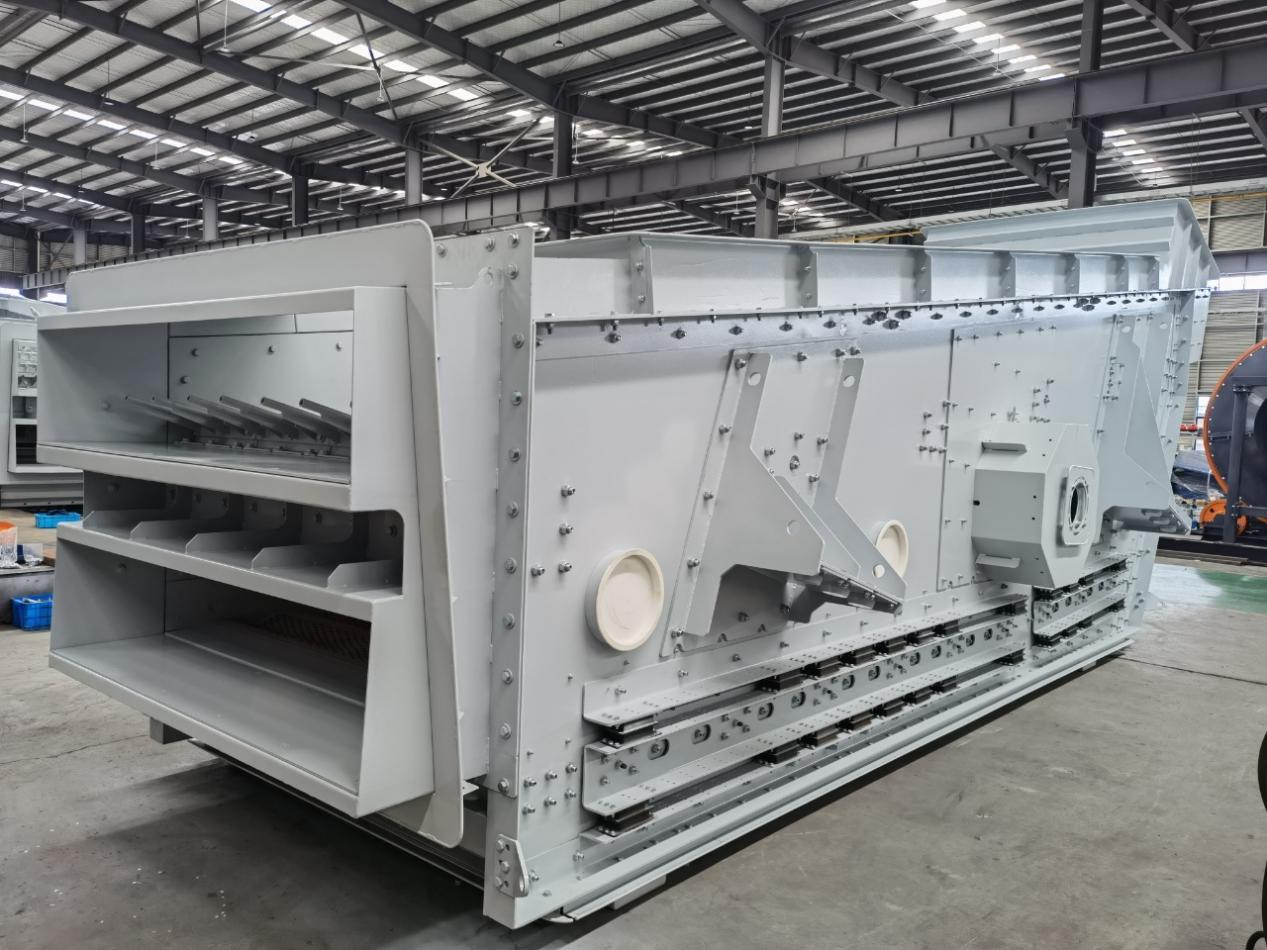
Product Introduction
The Composite Screen is a high-efficiency compound two-stage vibrating screening machine purpose-built for materials containing oversized items and wet, sticky materials. It specializes in medium and below particle size sorting operations, accommodating materials up to 250 mm. Widely adapting to organic materials, engineering spoil, aggregates, municipal solid waste, and other screening scenarios, it serves as a core screening unit for solid waste treatment, aggregate processing, and material classification industries.
The machine features an inclined installation structure. A flywheel exciter generates centrifugal force through rotation, driving the screen body in a stable reciprocating vibration. The upper deck is equipped with a welded 3D grid screen, with short bar grates mounted at the end of each screen panel. The grid screens are arranged horizontally in the transverse direction and in a stepped cascade layout longitudinally. During operation, materials tumble vigorously and break apart across the stepped screen deck, achieving high-efficiency separation. The welded screen deck withstands intense impacts from materials up to 250 mm. Oversized materials above the upper deck discharge from the outlet, while undersized materials fall through to the flexible screen deck below for secondary screening. The lower deck features a dedicated flexible screen panel structure. During equipment operation, the screen mesh continuously relaxes and tensions under inertial forces, creating a dynamic screening effect. Materials smaller than the screen opening specification rapidly pass through the screen panel for graded discharge, while larger materials are conveyed smoothly along with the screen body vibration to the discharge outlet. This design thoroughly addresses common industry pain points such as material agglomeration, short screen surface life due to high material impact, screen opening clogging, and incomplete screening.
The overall structure features user-centered engineering. The upper screen deck uses a modular design for rapid replacement and maintenance. The lower deck features a clamp-style bolt-free screen panel mounting structure, external dust covers, rubber damping components, and an electrical overload protection system, balancing operating efficiency, operational stability, and safety. The equipment also delivers low noise, high impact resistance, and a low failure rate, with simple disassembly, inspection, and maintenance procedures that substantially reduce equipment O&M costs and manual labor intensity, making it well-suited for long-term continuous industrial operation with exceptional versatility and practicality.
Key Advantages
The upper deck features a welded 3D grid arc screen deck arranged in a stepped cascade layout, increasing material tumbling frequency while delivering superior impact resistance and reducing flexible material bridging. The lower deck features a custom flexible screen panel that continuously relaxes and tensions dynamically during operation, effectively breaking apart agglomerated materials and eliminating screen opening clogging and material retention issues. Screen openings can be customized based on customer material specifications and screening requirements, adapting to diverse material classification operations with screening accuracy and operating efficiency far exceeding conventional screening equipment.
The exciter uses a modular design, allowing flexible adjustment of vibration amplitude by adding or removing counterweight blocks to suit materials of varying hardness, moisture content, elasticity, and friction. Combined with integrated rubber damping blocks, it efficiently absorbs equipment operating vibration and substantially reduces operating noise. The equipment base experiences minimal vibration amplitude, delivering smooth overall operation and low wear rates.
The upper deck uses modular bolted connection screen panel mounting — common tools enable rapid screen panel removal and replacement. The lower deck uses a bolt-free clamp-style screen panel fixing structure, allowing rapid lower deck screen panel removal and replacement without specialized tools. The space beneath the lower screen deck provides ample access for inspection and maintenance, with simple and convenient procedures that effectively shorten equipment downtime and reduce manual maintenance difficulty and O&M costs.
A professional electrical overload protection system automatically triggers an alarm and shuts down the equipment in the event of overload operation or current anomalies, preventing damage from overloading. The welded screen deck maintains stability under prolonged intense impact. The flexible screen panel offers excellent wear resistance, corrosion resistance, and impact resistance suitable for complex operating conditions. The equipment demonstrates strong overall durability and extended service life.
-
Rugged screen deck, efficient screening without clogging, integrated two-stage screening for higher efficiency
-
Modular and adjustable, with stable, low-noise operation
-
Easy disassembly and assembly, with minimal O&M costs
-
Intelligent protection for extended equipment service life
Technical Specifications
Lower deck 5-40
| Parameter | Specifications | Remarks | - |
|---|---|---|---|
| Model | JFH2070A | JFH2480A | - |
| Screen Deck Layers | 2 | 2 | - |
| Screen Surface Dimensions (m) | 2.0 x 7.0 | 2.4 x 8.0 | - |
| Number of Screen Panels | Upper deck 20 | - | - |
| Lower deck 18 | Upper deck 24 | - | - |
| Lower deck 22 | - | - | - |
| Mesh Size (mm) | Upper deck 40-80 | - | - |
| Lower deck 5-40 | Upper deck 40-80 | - | - |
| Dimensions (L x W x H, m) | 8 x 4.2 x 6 | 9.4 x 4.8 x 6.1 | - |
| Processing Capacity (m³/h) | 20-80 | 40-120 | Varies based on material properties and screening standards |
| Motor Power (kW) | 45 | 2 x 30 | Protection rating IP55 |
| Weight (t) | 18 | 28 | - |
| Max Feed Size (mm) | <=250 | <=250 | Designed for medium/small wet and sticky materials |
Application Scenarios
-
Solid Waste Treatment: Suitable for screening and classifying municipal solid waste, aged waste, industrial waste, and recyclable waste, supporting solid waste resource recovery and utilization.
-
Infrastructure Earthwork: Applicable to fine screening and contaminant separation operations for construction and renovation waste, engineering spoil, backfill soil, and crushed aggregates.
-
Resource Recycling: Used for size classification of various recycled metals and other recovered materials, meeting fine sorting production requirements.
Application Cases
-
Municipal Solid Waste Treatment Project: Multiple composite screen units deployed in municipal solid waste and aged waste sorting lines, performing precise material screening and effectively separating organic from inorganic materials. The equipment operates continuously and stably without material blockage and with minimal failures, substantially improving waste sorting efficiency and supporting urban solid waste harmless and resource-oriented treatment.
-
Aggregate Recycling Project: Applied in construction waste crushing and recycled aggregate screening scenarios, classifying recycled aggregates up to 250 mm with precise separation of coarse and fine aggregates. The equipment operates with low noise and high stability, with convenient O&M that effectively reduces production line operating costs and significantly improves finished aggregate quality.