
Product Introduction
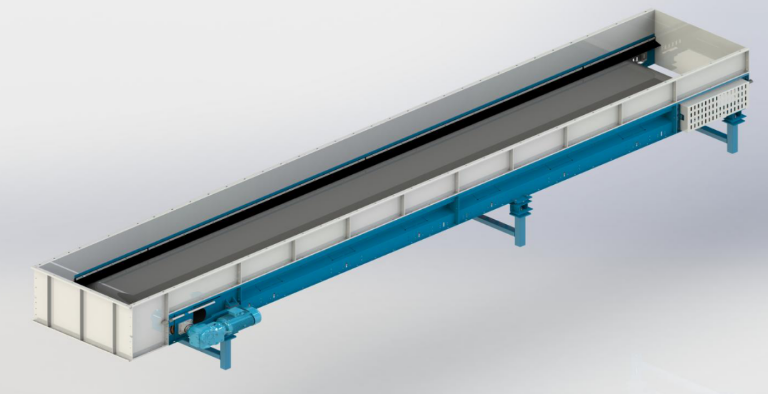
The universal mixed conveyor is a general-purpose conveying device purpose-built for industrial solid waste treatment scenarios. It is specifically designed for the horizontal transfer and sorting connection of irregular, entanglement-prone, and large-volume industrial solid waste materials such as fabric strips, waste wood, industrial offcuts, waste rubber, waste packaging, and construction waste.
The equipment adopts a standardized unit-based modular design, completely breaking away from the traditional conveyor limitations of on-site welding and concrete foundation dependency. It can be laid directly on level tunnel floors, concrete surfaces, or even compacted earth, requiring no civil construction whatsoever, significantly shortening the project construction timeline.
The entire machine frame uses high-strength, lightweight press-formed sheet metal components connected and secured with bolts, with each section’s weight kept within a reasonable range. All components can be disassembled into units compliant with international standard container shipping dimensions, facilitating sea and land transport — particularly suitable for logistics and on-site installation for overseas projects.
The drive unit uses an integrated geared motor that operates smoothly with high torque, equipped with multiple safety devices including overload protection, misalignment alarm, and emergency stop, meeting the demands of 24/7 continuous operation. The equipment can be flexibly spliced in length and adjusted in height based on site conditions, seamlessly interfacing with upstream and downstream equipment such as shredders, magnetic separators, air separators, and balers. It is widely used in various domestic and international industrial solid waste crushing and sorting production lines.
Core Advantages
-
Rapid Foundation-Free Deployment, Compact Footprint: No concrete foundation pouring required — the equipment can be laid and installed directly on level ground or tunnel floors, with a single unit fully commissioned and operational within the same day. The overall structure is compact, saving over 30% in floor space compared to traditional conveyors, making it particularly suitable for space-constrained workshops and temporary job sites.
-
Fully Modular Design, Convenient Overseas Transport and Installation: The entire machine is broken down into standard modular units whose dimensions fully fit 20/40 ft containers, keeping sea freight costs low. On-site assembly uses bolt connections with no welding required — general workers can quickly assemble the equipment. Overseas project installation cycles can be shortened by over 60%, significantly reducing overseas construction costs.
-
Side Guard Design to Prevent Spillage: Raised integrated side guard design eliminates material spillage and roll-off, keeping the work environment clean.
-
Universal Design, Low Installation Cost: Modular design allows factory pre-assembly of modules. Only splicing is needed at the project site, greatly reducing installation time and cost.
Technical Specifications
| Parameter | Customizable Range |
|---|---|
| Belt Width | 650 mm, 800 mm, 1200 mm, 1400 mm, 1600 mm |
| Conveying Inclination | 0 deg — 20 deg |
| Rated Throughput | 10—100 m^3/h |
| Belt Speed | 0.3—1.30 m/s (VFD adjustable) |
| Drive Motor Power | 3 kW, 4 kW, 5.5 kW, 7.5 kW, 11 kW, 15 kW |
| Standard Section Length | 3 m |
| Frame Ground Clearance | 500—1200 mm |
| Side Guard Height | 150 mm, 300 mm, 350 mm, 400 mm |
| Frame Material | Q235 carbon steel, 304 stainless steel (optional) |
| Belt Material | Rubber, anti-static PVC |
Application Scenarios
-
Domestic Industrial Solid Waste Treatment Plants: Post-shredding conveying and sorting of textile waste, waste wood, and industrial offcuts
-
Bulky Waste Dismantling Centers: Classified transfer of dismantled wood, fabric, plastics, and metals
-
Overseas Solid Waste Treatment Projects: Industrial solid waste and household waste treatment in Southeast Asia, Africa, the Middle East, and other regions
-
Temporary Solid Waste Yards: Rapid material transfer and loading
Application Case
Zhejiang Yiwu Industrial Solid Waste Crushing and Sorting Line Project: The Zhejiang Yiwu solid waste incineration and waste heat utilization project features an industrial solid waste crushing and sorting RDF system, primarily handling industrial waste offcuts, fabric strips, rubber, leather, plastics, and similar materials. The project procured 11 units of this series of modular horizontal belt conveyors for feeding, post-shredding conveying, material transfer during sorting stages, and pre-baling finished product conveying.
Since project commissioning, the equipment has performed exceptionally well, earning high recognition and praise from the client. Client feedback confirms that this series of conveyors perfectly meets the project’s conveying requirements for diverse and irregular industrial solid waste, with no spillage and no jamming, effectively ensuring the continuous and stable operation of the RDF system. The foundation-free installation design significantly shortened the project timeline and markedly reduced project construction costs. Additionally, the lightweight frame structure, convenient disassembly and assembly, and simple routine maintenance fully satisfy the project’s capacity needs. The client gave high marks for the equipment’s performance, practicality, and cost-effectiveness.