
Product Overview
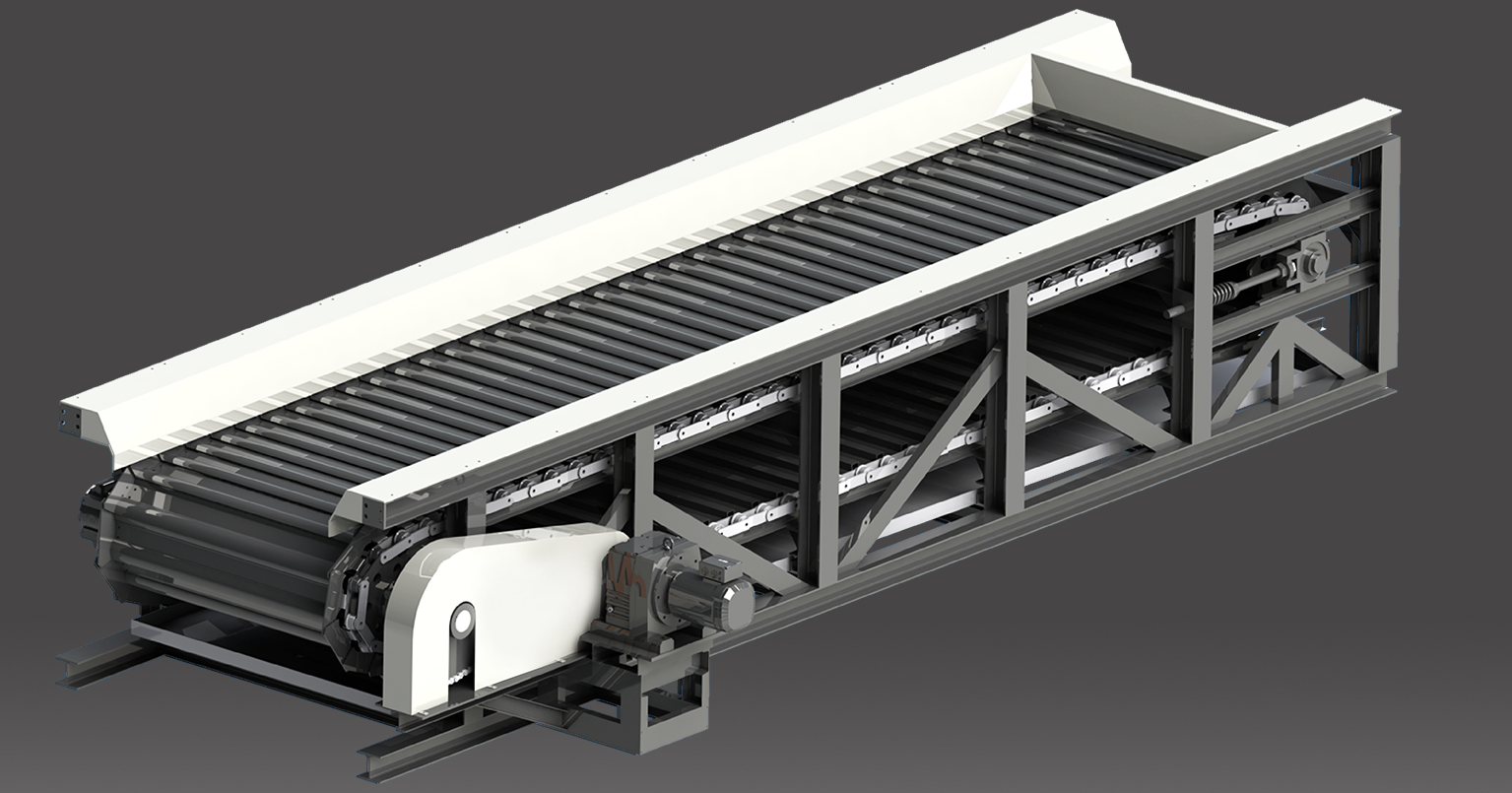
The heavy-duty chain conveyor is a piece of equipment designed for transporting high-tonnage, large-lump, highly abrasive, and high-impact materials. It features a load-bearing structure of high-strength chains and integrally stamped thick-gauge chain plates, with the entire frame welded from structural steel for high rigidity and deformation resistance, making it suitable for long-term heavy-load operation.
It is primarily used for conveying lump, bulk, or mixed materials along horizontal or inclined (<= 30 degrees) paths. In the solid waste sorting sector, it is mainly deployed for conveying construction and demolition waste and municipal solid waste, serving as a continuous feeding unit. The heavy-duty chain conveyor is a continuous conveying device that uses chain traction with integrally stamped metal plates as the carrying surface. Its core advantages include high load-bearing capacity, stable operation, adaptability to harsh conditions, variable-frequency speed control, and uniform feeding. It is widely used in industrial material transfer and process interconnection scenarios and is one of the key conveying assets on automated production lines.
Its core structure is simple and compact, primarily consisting of conveyor chains, conveyor chain plates, a drive unit (geared motor, bearings, sprockets), and a tensioning unit (bearings, lead screws, sprockets). The drive sprocket provides tractive force to the chains, and the metal chain plates — fixed between the chains on both sides as the carrying element during conveying — are driven in reciprocating motion as the sprockets cyclically pull the chains, thereby moving material horizontally or on an incline along with the plates. The chain plates are arranged in a corrugated pattern to effectively minimize material leakage.
Key Advantages
-
High load-bearing capacity: the combined chain-plate-plus-chain design can convey single heavy items or bulk materials in volume.
-
Stable and reliable operation: high-precision chain drive with no belt slippage, uniform conveying speed, and a low failure rate.
-
Suitable for harsh operating conditions: high-temperature resistant, wear-resistant, and corrosion-resistant, capable of long-term operation in dusty, humid, and high- or low-temperature environments.
-
Low maintenance costs: core components have a long service life, are easy to replace, and require only simple routine maintenance.
Technical Specifications
| Parameter | Specification |
|---|---|
| Conveying Width | 1200-3000 mm |
| Conveying Angle | 0-30 degrees |
| Rated Throughput | 30-500 m³/h |
| Conveying Speed | 0.15-0.3 m/s |
| Motor Power | Model-dependent (5.5-30 kW) |
| Max Single Unit Length | Customizable per requirements (2-30 m) |
| Frame Material | Q235 carbon steel / SUS304 |
| Chain Plate Process | 8 mm, integrally stamped |
Application Scenarios
-
Mining and Quarrying: quarries, crushing production lines, aggregate processing, raw ore transfer
-
Waste Recycling: front-end feeding and transfer for construction and demolition waste and solid waste treatment
-
Machinery Manufacturing: conveying and transfer of machined parts, casting cooling, and assembly line materials
-
Metallurgy and Smelting: heavy-item transport in steel plants, smelters, mineral powder, and furnace charge handling